
Securing your printers is no longer optional. As businesses expand their digital ecosystems, the printer network has quietly become a common entry point for cybercriminals. From data breaches to compliance failures, printer security vulnerabilities are increasingly making headlines in cybersecurity news and for good reason.
Modern printers are connected endpoints. They store data, access the internet and integrate with enterprise systems. Without the right strategy in place, organizations face growing network printer security risks, which can cause significant operational disruption.
This blog explores the broader business implications of weak printer security and what organizations can do about it.
Key Takeaways
Printers are connected endpoints, making them a security risk.
In retail, printers power mission-critical workflows, making breaches especially costly.
A single printer hack can expose sensitive financial and customer data.
Securing printers requires visibility, encryption, access controls and centralized management.
Proactive printer security management reduces downtime, compliance violations and financial impact.
Understanding the Threats: Why Printer Security Matters
Organizations invest heavily in endpoint security, yet printers are often overlooked. The global average cost of a data breach reached $4.44 million in 2025. While not all breaches originate from printers, unsecured endpoints significantly increase the risk of an attack, and printers are commonly unsecured.
In fact, 67% of organizations reported at least one print-related data loss incident in 2024, making printer security a growing concern.
Why Retailers Face Elevated Printer Security Risks
The risk of data exposure is amplified in retail, where printers are fundamental to daily operations. Retailers rely on a mix of printers, including thermal, mobile and industrial printers, to produce shelf labels, shipping labels, receipts and RFID tags. These printers support everything from customer transactions to back room inventory workflows. When they fail, operations slow down, customer experiences suffer and supply chains lose efficiency.
The impact extends beyond internal operations. Consumers are increasingly concerned about retail security practices. According to SOTI’s 2026 Retail Report, 45% of consumers worry about how retailers store and use their data when they make a purchase or a return, and 49% worry about who is responsible for protecting their data when using third-party payment solutions. For retailers that depend on fast, accurate and secure print workflows, addressing these risks must be a core cybersecurity priority.
It only takes one compromised device within your printer network to unlock access to the broader IT infrastructure.
Are Old Printers a Security Risk?
Yes. Legacy devices often lack modern firmware updates, encryption standards and authentication controls. When no longer supported, these devices become unmanaged endpoints and introduce security risks.
Older devices may:
Store print jobs locally without encryption
Use default credentials
Lack audit logging
Be incompatible with zero-trust security models
In other words, aging hardware dramatically increases printer security vulnerabilities.
What Happens if a Printer Is Hacked?
When a printer is successfully hacked, it can lead to:
Data theft
Stolen credentials
Ransomware attacks
Email-based attacks
Compliance issues
Operational slowdowns
For retailers, the impact often extends beyond IT systems. A printer‑related cyberattack can disrupt labeling, fulfillment and checkout processes, leading to delays on the floor and in the supply chain.
These incidents also affect customer trust. Close to 90% of customers think twice before shopping with retailers that have experienced a cyberattack. Lost trust can quickly turn into lost revenue, highlighting the broader financial impact of weak printer security.
How to Secure Your Printers from Cyber Threats
Effective printer security requires layered protection across all printers, networks and users.
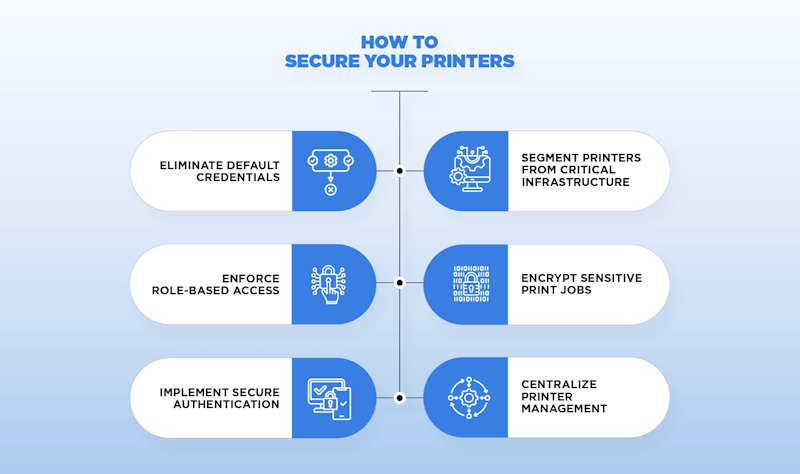
1. Eliminate Default Credentials
Customized, complex credentials should be used by all employees across your organization.
2. Enforce Role-Based Access
Not all employees should have the same access. With role-based access, IT admins can ensure printer network security is set up accordingly.
3. Implement Secure Authentication
Whether you require employees to use a certified NFC badge, PIN or single sign-on (SSO), any printing job should require authentication.
4. Segment Printers from Critical Infrastructure
While printers are part of your device fleet, they should be segmented from sensitive systems when possible. This limits exposure and helps prevent attackers from accessing critical information.
5. Encrypt Sensitive Print Jobs
Documents sent to printers may contain sensitive information. If print jobs aren’t encrypted, anyone could print and view the data. Encrypting print jobs ensures that only the employee who sent the job can retrieve it, keeping the information secure.
6. Centralize Printer Management
Centralized printer management is essential for security. Solutions like SOTI Connect help organizations monitor printer health, track battery levels and print cycles, enforce password policies and deploy security certificates at scale.
What to Do if Your Printer Gets Hacked?
Immediate Steps After a Printer Security Incident
Disconnect the device from the network
Preserve logs and system data
Notify your IT security team
Begin incident response protocols
Isolating the device quickly helps prevent further criminal movement across your network.
Immediate Steps After a Printer Security Incident
Conduct regular printer security audits
Keep firmware updated across all devices
Replace unsupported hardware
Use centralized device management
Monitor continuously for suspicious activity
Proactive monitoring significantly reduces long-term printer security risks.
Take Action to Keep Your Printer Fleet Safe
Printers are no longer simple output devices. Whether handheld or rugged, they are connected endpoints that can create serious security risks if left unprotected. Securing your printer fleet helps reduce breach risk, maintain compliance and protect sensitive data.
To learn about a leading printer management solution, contact us today or book a free demo.
Additional Resources
The following blogs are great resources for strengthening printer security at an enterprise level:
Printer Security Management: Fix Hidden Risks with SOTI Connect: Take a deeper look at printer mitigation strategies.
The Future of Incident Management with Remote Access Software: Strengthen remote response capabilities and improve response times during a suspected printer hack.
Paper Is a Security Risk | Digitize Paper & Protect Your Business: Explore how reducing physical document dependency enhances overall printer security posture.